
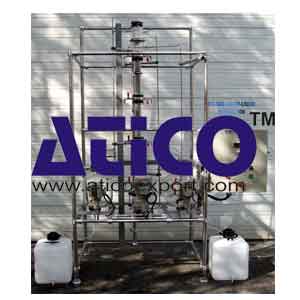
Pulsed Liquid Liquid Extraction
Categories: Lab Equipment
Product Code: APC011




About this product
Pulsed Liquid Liquid Extraction
Main characteristics of the pilot
Pulsed Liquid Liquid Extraction- Industrial instrumentation
- Borosilicate glass and stainless steel AISI 316L manufacturing
- Rigid process pipes
- Pulsing device by piston pump
- Graduated glass receivers
Principle and Operation:
Liquid-liquid extraction allows the transfer of a solute (dissolved in feed solvent to make the solution) into an extraction solvent with which it has more affinity; the feed solvent and the extraction solvent are not miscible. The light phase is introduced at the bottom of the column then climb toward the superior decanter. The heavy phase introduced at the head of the column flow down toward the decanting area situated at the bottom. The piston pump, positioned where the bottom decanter is found, generates pulses throughout the column; this agitation allows a mixing of the two phases flowing at counter-current and the transfer of the solute to extract into the solvent. The decanters are used to separate the immiscible phases; the extract phase, enriched in solute, and the raffinate phase, depleted in solute, are carried out in a continuously way from the decanters.
Teaching objectives
- Study of the following experimental parameters :
- Influence of solution and solvent flow rates
- Influence of agitation.
- Calculations :
- Mass balance.
- Number of theoretical plates (McCABE and THIELE, ternary diagrams).
- Number of transfer units.
- Calculation of the mass transfer coefficient.
Technical Specifications of Pulsed Liquid Liquid Extraction
Equipment:- Two storage tanks of the solution and the extraction solvent made of Polyethylene.
- Feeding metering pump of the solution, 316L stainless steel body, PTFE diaphragm, manual control
- Feeding metering pump of the extraction solvent, 316L stainless steel body, PTFE diaphragm, manual control
- Lower decanter in borosilicate glass with introduction of the light phase, outlet of the heavy phase and sampling valve
- Upper decanter in borosilicate glass with introduction of the heavy phase, outlet of the length phase by overflow and sampling valve.
- Borosilicate glass column in three pieces with “MULTIKNIT” type packing made of AISI 316L stainless steel.
- AISI 316L stainless steel pulsing assembly with frequency and amplitude adjustment.
- Four AISI 316L stainless steel sampling plates.
- Extract phase receiver tank in borosilicate glass with drain valve.
- Raffinate phase receiver tank in borosilicate glass with drain valve.
- AISI 316L stainless steel connecting tubes.
- Support framework with AISI 304L stainless steel tubes, aluminium connecting nuts and adjustable feet.
Instrumentation:
- Command and control cabinet fitted with an emergency stop, operating buttons and the following interfaces:
- Pulse frequency controller.
- Digital temperature indicator with two Pt100 Ω type probes.
Dimensions and weight
- 1500 mm x 850 mm x 3250 mm ~ 120 kg.
Essential requirements
- 230 V / 50 Hz / Single phase:1 kW.
Related Products

HPLC
Atico India is a leading HPLC manufacturer, providing high-quality High Performance Liquid...
PCR Thermal Cycler
Welcome the world of molecular biology with a PCR thermal cycler from the top PCR thermal...
Friction Loss In Pipes And Fittings Apparatus
Description:- This equipment consists a set of 5 variable-sized PVC pipes manifolded and...
Bomb Calorimeter
Measuring the heat of combustion requires robust equipment. Before the 1800s, the need for...
Hamburg Wheel-Tracking Tester
The Hamburg Wheel-Tracking Tester is used to test submerged, compacted Hot Mix or Warm Mix...
Dynamic Loading System
Dynamic Loading System was designed and developed for the investigation of masonry wall be...
Automatic Marshall Compactor With Rotating Base
Humboldt Automatic Marshall Compactor With Rotating Base machine are designed to provide s...
Asphalt Coring Machine
The Laboratory Asphalt Coring Machine is capable of achieving a large range of spindle spe...